Thursday, October 14, 2010

Giveaway from "Made with Love" blog

 
In celebration of blogging for a whole year, Jenni from Made with Love blog hosts a giveaway!

Giveaway winners will be announced on October 19th seeing as that is the birthday of Made with Love! Visit the blog here to enter.

Good luck,

KP

Facebroidery by Cate Anevski

Cate Anevski is an artist, illustrator and maker extraordinaire! You can easily understand this if you visit her blog and her wonderful etsy shop! I must say that I fell in love with her facebroidery that you see in the pictures above. What a clever idea and how well executed.

KP

Friday, October 8, 2010

Hair Embroidery by Kate Kretz


After my post about hair embroidery and its origins, I searched the internet to find people who do hair embroidery. In one of my searches I found Kate Kretz, who I think is a very good representative of this kind of embroidery. Of course I do not compare her work with the traditional hair embroidery as it was done in China for hundrends of years. The theme of her work is rather different as you can see from the pictures - no Buddha and birds or pandas. I don't know much about the technque she uses, but the final result is astonishing.


You can see more of Kate's work in her blog and in her website.

KP

Thursday, October 7, 2010

HOW-TO Videos: Stem stitch

In two previous posts (1, 2) I showed you video tutorials that demonstrated the basic stitches in cross stitching: cross stitch, half cross stitch, quarter cross stitch, back stitches and French knot stitches. There are many more stitches that I think are very useful to know cause they can add different texture to an embroidery work: stem stitch, chain stitch, satin stitch, split stitch, seed stitch, and fly stitch. So, my next series of HOW-TO videos will be around these stitches. 

I will start with the next video demonstrating how to do a stem stitch.


I hope it is helpful! What is your favorite stitch, or the one that you consider essential to know?

KP

Wednesday, October 6, 2010

Book giveaway from Mary Corbet's Needle'n Thread blog


There is a new book giveaway from Mary Corbet's Needle'n Thread blog that I follow. The book that is given is a copy of the new edition of Stitch Sampler.

To enter the giveaway read the information in Mary's post here. The giveaway ends on October 10th.

Good luck

KP

Bumblesea indie jewelry blog contest & giveaway


Enter the jewelry giveaway sponsored by Bumblesea indie jewelry / indie fashion blog. You get to choose which necklace you’d like. The contest ends on November 1st.

Good luck,

KP

Monday, October 4, 2010

The Art and Science of Happiness: Patricia Dahlman


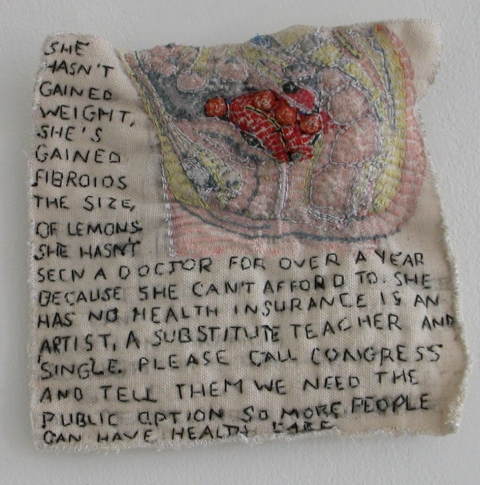
A while ago I wrote a post about Patricia Dahlman and how  she uses embroidery to express her artistic temperament. I was very glad to hear that she participates in an exhibition.

Her multimedia work was selected by a panel of visual arts professionals to provide a visual component to the Rutgers Institute for Research on Women's 2010-11 interdisciplinary seminar, "The Art and Science of Happiness." The theme explores how economic security, political stability, family, careers, health, community involvement, and other domains contribute (or not) to ones sense of being "happy." Dahlman's subject matter ranges across the political, social, and economic spectrums, while addressing issues of nature and society. She uses sewn and stitched forms made from canvas and colorful fabric to create both sculptural and 2-dimensioal works that are playful or serious, and sometimes both. The works selected for this exhibition include landscapes, abstract forms, narratives and figural works that comment on the environmental destruction in her community as well as recent political events in America. They represent her visions and hopes for an improved future for society and the world.

Barack Don't Let the Left Down

 She Has No Health Insurance

You can find more information for the exhibition here.  You can see more of her work here

KP

Sunday, October 3, 2010

Embroidery in Art - Peter Crawley's stitched illustrations


 Empire State Building

Another great example of using embroidery out of the ordinary are Peter Crawley's stitched illustrations. Peter's illustrations are created by piercing 420gsm watercolour paper with a pin and then stitching the paper with cotton thread. His stitched Illustration subject areas to date have included architecture, typography and geometric patterns.

America map

 Moiré Lines                                             Circle       

In his site here you can see much more of his work.

KP

Thursday, September 30, 2010

Hair Embroidery

Hair embroidery has its origins from China. As the name indicates, it refers to embroidery where human hair is used as a thread instead of other materials. Since Chinese people generally have black hair, embroidery is also called "Moxiu" (black embroidery).


Hair embroidery generally falls into two categories: monochrome hair-embroidery and colored hair-embroidery. Unlike monochrome hair embroidery, where the color is limited to black, in colored hair embroidery, others, such as blonde, amber, auburn, white and grey of various shades, collected from people of different races, are also used.


I believe that it needs much effort and special skills to complete a piece of hair embroidery. A quick search on the internet revealed sites that sell and buy human hair to be used in hair embroidery. However, I couldn't find how much it costs. So, have you ever tried hair embroidery?

KP

Thursday, September 23, 2010

Lacemaking in Croatia


Some time ago I posted here about the inscription of Cyprus Lefkara lace on UNESCO's Representative List of the Intangible Cultural Heritage of Humanity. Croatia is another country whose lace also inscribed in this list. The video that follows describes lacemaking in Croatia.


At least three distinct traditions of Lacemaking in Croatia persist today, centred on the towns of Pag on the Adriatic, Lepoglava in northern Croatia and Hvar on the Dalmatian island of the same name.


Pag needle-point lace was originally used to make ecclesiastical garments, tablecloths and ornaments for clothing. The process involves embellishing a spider web pattern with geometrical motifs and is transmitted today by older women who offer year-long courses.


Lepoglava bobbin lace is made by braiding thread wound on spindles, or bobbins; it is often used to make lace ribbons for folk costumes or is sold at village fairs. An International Lace Festival in Lepoglava celebrates the art every year.


Aloe lace is made in Croatia only by Benedictine nuns in the town of Hvar. Thin, white threads are obtained from the core of fresh aloe leaves and woven into a net or other pattern on a cardboard background. The resulting pieces are a symbol of Hvar. 


Each variety of lace has long been created by rural women as a source of additional income and has left a permanent mark on the culture of its region. The craft both produces an important component of traditional clothes and is itself testimony to a living cultural tradition.

KP

Sources:
Ministry of Culture of Croatia

Wednesday, September 8, 2010

Favorite Blog: Hand Embroidery from Sadalas....


I recently become a follower of the blog of Lakshmi Sadala, called "Hand Embroidery from Sadalas....".

Lakshmi is an Indian lady and in her blog she has many video tutorials created by her showing traditional indian embroidery stitches and embroidery in general. I really like indian embroidery and the blog has plenty of useful information.

Image taken from a Lakshimi's video showing the indian version of long and short stitch.

For anyone interested it is a good embroidery source! You can visit it here.

KP

Tuesday, September 7, 2010

Encyclopedia of Needlework by Thérèse de Dillmont


I discovered a comprehensive book on needlework that contains both verbal and pictorial descriptions of everything included under the name of needlework and is free online for everyone to read. The book is called "The Encyclopedia of Needlework" by Thérèse de Dillmont (1846-1890). It was published in 1884, and is considered a classic reference book one can turn to for time-tested information. 

It consists of sixteen chapters that include Sewing, Mending, Single and Cut Open Work, Net and Damask Stitches, White Embroidery, Flat and Gold Stitch Embroidery, Tapestry and Line Embroidery, Knitting, Crochet, Tatting, Netting, Irish Lace, Laces of Different Kinds, Miscellaneous Fancy Work, and Practical Directions.

The Encyclopedia of Needlework is presented here in it's entirety.

KP

Monday, September 6, 2010

My needlelace stars


These handmade accessories look like stars and they are my latest additions to the shop. They are made of a dark gold lace tape, close-stitched together with gold thread. Again two needle-lace creations! They can be blind-stitched on any garment, like a pair of jeans, a blouse, a jacket, a scarf, or a hat and a purse, to give it a fresh look. They can be used as coasters, or be framed and hanged on a wall, even glued on a card or lampshade! 


I hope you liked my lace stars! Any more ideas on how else they can be used are welcome!

KP

Friday, September 3, 2010

Summer is over...

Hello everyone!

I am back from my vacations to Kos island. The island is beautiful and we had a great time. We visited many archaeological monuments that are scattered all over the island,  castles, ancient temples, old theatres and the Ancient Market.  Over time Romans, Byzantines, Ottomans and Italians have passed through the island leaving their marks on it.

Kos is the birthplace of Hippocrates, the father of medicine. We saw the Tree under which he used to teach. It still stands in the centre of the town, being the oldest tree in Europe and one of the oldest worldwide (more than 2000 years old). The Asklepieion is undoubtedly the most important monument that we visited, the oldest and most famous centre of healing in the ancient world. 

I should not forget to mention all the beautiful sandy beaches that we visited!  

That's it. Kos island is one of my best places to be!

KP

Friday, August 13, 2010

On Vacation Mode!!!!

I am off on vacation with my husband till the end of August! I will be on beautiful Kos island in Greece! 


Greedings everyone!!!

KP

Wednesday, August 11, 2010

My Dream Canvas Blog Giveaway


There is a Giveaway of a pair of beautiful earrings at Anu's "My Dream Canvas" blog which I follow. This Giveaway is open to everyone! The winner will be  picked on Sunday Aug 15th.

The earrings are handmade by Joanna who runs a customized jewelry store on Etsy. You can visit it for some incredibly pretty jewelry.

To enter the Giveaway you should follow the instructions written in Anu's blog here

Good luck to everyone!

KP

Friday, August 6, 2010

Embroidery in Art - Patricia Dahlman


Some time ago I wrote a post about embroidery as a form of art through the artistic work of Olja Stipanovic. Patricia Dahlman is another artist I discovered in the Internet that uses embroidery to express her artistic temperament. She works on canvas, cutting out forms, then stuffing and sewing them together. These stuffed, sewn forms are either stitched using different colors of thread or painted with acrylic paint.
 
Her three-dimensional sewn forms are based on photographs from news magazines and off the Internet of people such as George Bush and events like the insurgency in Iraq.  The creation that follows, named "Freedom?", is a good example.


The subject matter of her work is taken from personal thoughts, life experiences and reactions to political events around the world.


My favorite creation is this one called "Family".


Short Bio:
Patricia  Dahlman was born in Cincinnati, Ohio and studied art at Wright State University in Dayton, Ohio and Yale University Summer School of Music and Art in Norfolk, CT. Patricia has received a New Jersey Printmaking Fellowship at Rutgers Center for Innovative Print and Paper, two Geraldine R. Dodge Foundation Fellowships to attend Vermont Studio Center and Virginia Center for Creative Arts, a Yaddo Residency and a Puffin Foundation Grant for the War and Peace Print Project. Patricia has shown her work all over the United States and exhibited recently at George Adams Gallery in NYC, 621 Gallery in Tallahassee, FL and Jersey City Museum in Jersey City, NJ. Upcoming exhibitions include a solo show at "Art in the Windows" at the New York Public Library, Mid-Manhattan Library in NYC. Patricia lives and works in Lyndhurst, NJ with her husband the artist, Michael Dal Cerro.
 
You can see more of her work here.

So have you used or seen other people use embroidery in a similar or other contemporary  artistic way?

KP

Thursday, August 5, 2010

Greek Folklore - Lefkara laces or Lefkaritika


I found this interesting video talking about the "story" of lefkara laces. Lefkara lace inscribed in 2009 on UNESCO's Representative List of the Intangible Cultural Heritage of Humanity.


The tradition of lace-making in the village of Lefkara in southeastern Cyprus dates back to at least the fourteenth century. Influenced by indigenous craft, the embroidery of Venetian courtiers who ruled the country beginning in 1489, and ancient Greek and Byzantine geometric patterns, Lefkara lace is made by hand in designs combining four basic elements: the hemstitch, cut work, satin stitch fillings and needlepoint edgings. 


This combined art and social practice is still the primary occupation of women in the village who create distinctive tablecloths, napkins and show pieces while sitting together and talking in the narrow streets or on covered patios. 


Unique mastery of the craft is passed to young girls through years of informal exposure and then formal instruction by their mother or grandmother in applying cotton thread to linen. When she has learned her art thoroughly, the lace-maker uses her imagination to design work that embodies both tradition and her own personality. Testament to the ability to appreciate multiple influences and incorporate them into one’s own culture, lace-making is at the centre of daily life for women of Lefkara and a proud symbol of their identity.

KP

Sources:
Ministry of Culture of Croatia.

Wednesday, August 4, 2010

Dancing with the lace


Here are my latest lace creations. These handmade accessories are inspired by Pablo Picasso’s artwork on "dancers" done with a single stroke. They are made of a silver lace tape, close-stitched together with corresponding silver thread. They can be used as embellishments and applique's and be blind-stitched on any garment, like a pair of jeans, a blouse, a jacket, a scarf, or a hat and a purse, to give it a fresh look. They can also be framed and hanged on a wall, even glued on a card or lampshade!


I hope you liked my lace dancers! Any more ideas on how else they can be used are welcome!
 
KP


Monday, August 2, 2010

Greek Folklore - An Introduction to Greek Embroidery


Before I start presenting Greek traditional embroideries from different regions of Greece, I think that an introduction to Greek embroidery in general is necessary. 

Greek embroidery flourished between the middle of the 17th and the end of the 19th centuries. Embroideries were used to decorate the home, adorn traditional costumes, ecclesiastical garments and cloths. They could be identified according to their place of origin - Asia Minor, Constantinople, Cyprus, Thrace, mainland Greece, the Aegean or Ionian islands. Each region developed quite different styles and repertoires of designs using linen, cotton, and silk. Varying populations -- urban foreigners and rural natives, Catholic towns and Orthodox villages, invading navies and armies -- all contributed to a fusion of styles and motifs that led to one of the greatest displays of decorative folk art to be found anywhere in the world.

The styles range from aristocratic and patrician designs from Rhodes, the monochrome geometric work of Naxos, to the exuberant narrative style of Skyros and the Ottoman-influenced work of Epirus. Although styles and designs were transmitted either through commerce or marriage, particularly in the islands, strong regional patterns and techniques were preserved.
 
Depending on the materials used, Greek embroideries could be classified as (a) colored, worked in dyed threads, (b) white, using white silk or cotton threads, (c) lace, worked in cotton with needles, crochet or bobbins, and (d) gold-embroidered, produced with the use of metal threads, gold and silver wire and gilded wire.
 
The decorative motifs were arranged horizontally, vertically, diagonally or in a circle with patterns repeating or alternating. For example, bouquets or vases of flowers might alternate with cypress trees throughout an entire piece. Certain motifs were more popular such as the "tree of life" - a motif in Christian art referring to the Cross, signifying resurrection and eternal life, and also, fruitfulness and nature's bounty. Other common motifs were crosses, birds, flowers, double-headed eagles, churches, rosettes, anthemia - honeysuckle or palm leaves in radiating clusters, and geometric patterns.
 
The following embroideries are from the Greek Institute's permanent collection of embroideries, textiles and folk costumes.
 
 Table cover from Mytilene/Chios - a patchwork of motifs joined by Venetian-style lace
Silk and gold thread on cotton and linen - Wide variety of stitches, bobbin lace

Towel from Thrace - stylized men and women dancing
Silk thread, gold and silver wire on cotton - Counted thread and satin stitches

Tsevres from Thrace - "vase of life" with poppies and cypress trees
Silk thread, gold wire on cotton - Counted thread stitch


Can't wait to show you my handmade thracian tsevredes!

KP

Source:
Parts of the text and the photos are from the Greek Institute